 Listicle
Commercial Property Drainage Maintenance Solutions That Work
Quick Summary
Effective drainage maintenance for commercial property starts with a written checklist and a monthly walk of the site after heavy rain. Logging each finding with a date and photo lets managers track problems and plan repairs before they become costly.
- Walk the property monthly, especially after heavy rain, to spot pooling water.
- Clear grates, catch basins and inlets of debris monthly during the growing season.
- Log each finding with a date and photo to track whether problems worsen.
- Regrading low spots can fix repeated flooding that cleaning alone will not solve.
- Budget separately for recurring checklist items and larger repairs.
Table of Contents
- Commercial Drainage Maintenance Checklist for Property Managers
- Commercial Storm Drain Maintenance and Exterior Drainage Solutions
- Planning Your Next Drainage Maintenance Step and Budget
- Frequently Asked Questions
Commercial Drainage Maintenance Checklist for Property Managers
Last Updated: November 12, 2026
Standing water in a parking lot or a blocked storm drain can close a site within a day. Property managers who keep a simple, written drainage checklist usually spot problems before they become expensive repairs.
Start with a monthly walk of the property after heavy rain. Look for pooling water, eroded soil at downspouts, cracked catch basins and grates clogged with leaves or debris. Log each finding with a date and a photo so you can track whether a problem is getting worse. A short, consistent record is more useful than a long inspection done once a year.
Add these items to every checklist:
- Clear grates, catch basins and inlets of debris each month during the growing season
- Confirm that gutters and downspouts discharge away from buildings and walkways
- Check grading around the building perimeter for low spots that hold water
- Inspect sidewalks, curbs and parking surfaces for cracks where water enters the base
- Review the record of any sewer or lift station service, and flag overdue items
Many property managers find that a checklist also helps them plan budgets. Recurring items such as debris clearing cost little, while regrading or pipe replacement costs much more. For the deeper guide, see commercial lift station maintenance. Recording the frequency of each problem makes it easier to justify preventive work to an owner or board.
The checklist items below summarise what to inspect and how often, as described in the article.
| Checklist item | Frequency or timing | Purpose |
|---|---|---|
| Walk the property | Monthly, after heavy rain | Spot pooling water and damage |
| Clear grates, catch basins and inlets | Monthly during growing season | Prevent debris blockage |
| Check downspout discharge | Routine checklist item | Keep water away from buildings and walkways |
| Check grading around perimeter | Routine checklist item | Find low spots that hold water |
| Inspect sidewalks, curbs and parking surfaces | Routine checklist item | Find cracks where water enters the base |
| Review sewer and lift station service record | Routine checklist item | Flag overdue service |
Commercial Storm Drain Maintenance and Exterior Drainage Solutions
Storm drains and exterior drainage carry water away from the property, and they fail quietly. A cracked pipe or a silted inlet may show no sign until a storm overwhelms it. Commercial sites often have more drainage components than residential lots, including storm drains, catch basins, swales and retention areas.
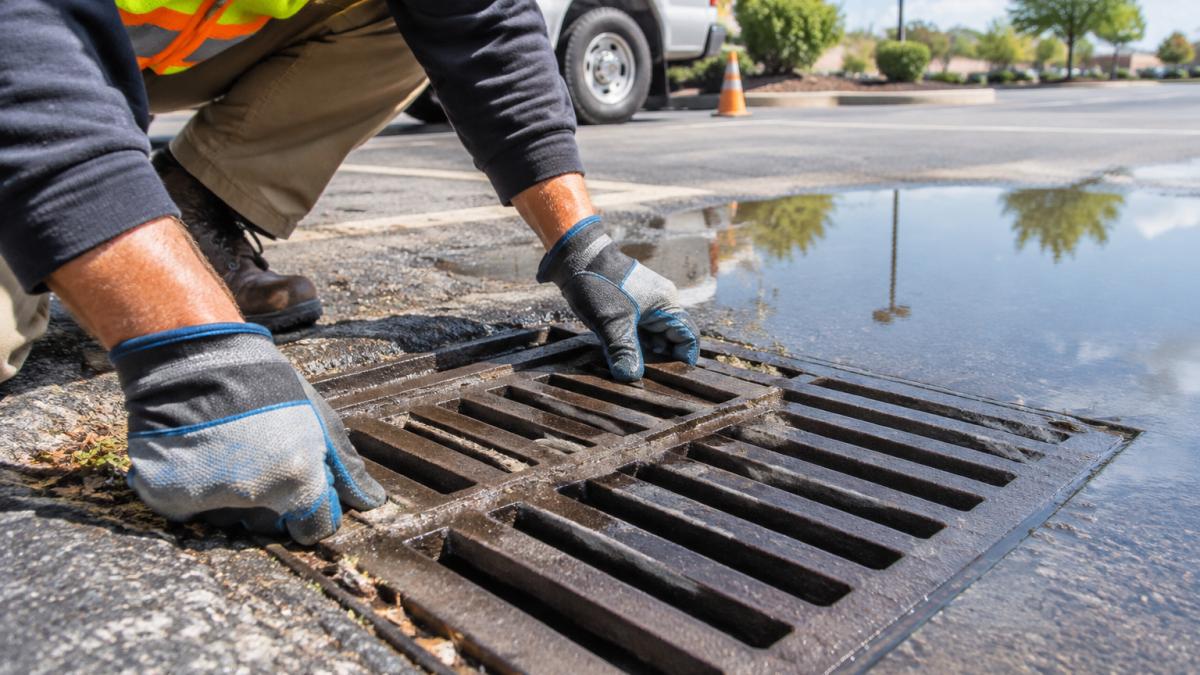
Exterior drainage solutions usually fall into three groups: cleaning and clearing existing lines, correcting grading so water flows where it should, and installing new components such as trench drains or dry wells. For a step-by-step walkthrough, see dry well installation steps. Review the grading, trenching and waterway services offered for these fixes. Grading is often the root cause when the same area floods repeatedly. Regrading low spots can solve a problem that cleaning alone will not fix. Read what to ask a grading contractor before you commit.
Keep a short list of contractors who can perform trenching, grading and storm drain work, and check that each one is licensed and insured before you need them.
Planning Your Next Drainage Maintenance Step and Budget
Before approving any drainage work, define the goal: stop flooding in one area, protect a building, or meet a maintenance schedule. A clear goal keeps the scope tight and makes it easier to compare quotes.
Ask each contractor for a written estimate that lists the work, the materials and the expected timeline. Find more practical notes on property work and preparing ground for what comes next. Pricing depends on site size, soil conditions and access. For current pricing, request a quote from Busy Man Contracting LLC directly.
Budget in two tiers. Set aside a recurring amount for routine items on your checklist, and a separate reserve for larger repairs. Reviewing both each year helps you avoid emergency spending when a drain fails during a storm.
Frequently Asked Questions
How much does commercial drain maintenance cost?
Cost depends on the size of the property, the number of drains and storm structures, the access needed, and whether the work is a routine cleaning or a repair. Routine service is usually cheaper than emergency work, and recurring maintenance agreements can lower the per-visit rate. Because pricing varies so much by site, the most accurate figure comes from a written quote after an on-site walkthrough. Busy Man Contracting LLC can provide a quote for your property.
How often should commercial storm drains be cleaned?
Most commercial properties benefit from inspecting storm drains at least twice a year, typically before and after the heaviest rain season. Sites with heavy leaf litter, construction debris, or parking lot sediment may need cleaning more often. A written inspection schedule makes it easier to spot clogs early and track what was done and when.
Who should you call for drainage problems on a commercial property?
Start with a contractor who handles both the surface grading and the underground drain lines, since poor grading is a common cause of standing water. Ask whether they inspect before recommending work, whether they document conditions, and whether they can handle recurring maintenance. Busy Man Contracting LLC offers grading and trenching for residential and commercial properties, so you can request a quote from the company directly.