 How-to
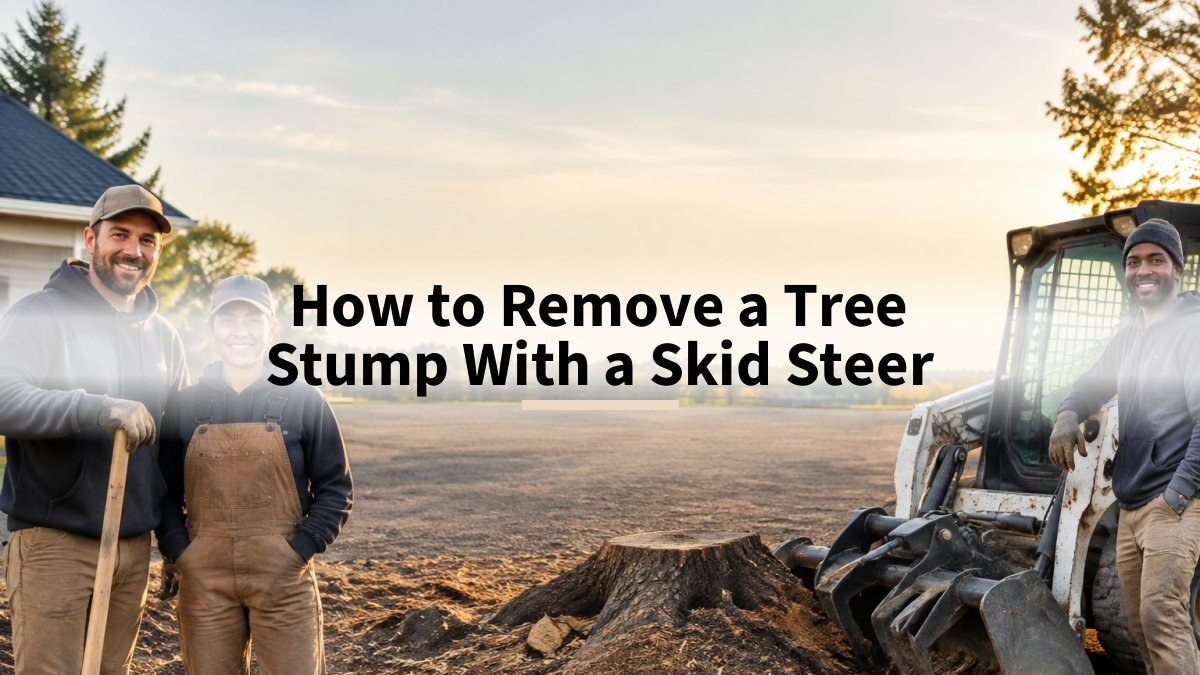
How to Remove a Tree Stump With a Skid Steer
Table of Contents
- Choosing the Right Skid Steer and Attachment
- Safety and Site Preparation Before You Dig
- Step-by-Step: Digging, Cutting Roots and Pulling the Stump
- When to Rent a Stump Grinder or Skid Steer Instead
- Booking Your Stump Removal With Busy Man Contracting
- Frequently Asked Questions
Last Updated: November 8, 2026
Many property owners ask how to remove a tree stump with a skid steer? Yes, a skid steer can remove most tree stumps, but only with the right attachment, a careful plan, and patience to work the stump loose rather than fight it.
USDA Forest Service guidance on tree root systems and soil
Choosing the Right Skid Steer and Attachment
Not every skid steer is up to the job. The attachment decides how deep you can dig and whether the stump comes out in one piece; the machine decides whether the tool can do that safely.
Most stump removal relies on a few attachment types:
- Stump bucket or stump grapple: A narrow, heavy-duty bucket with a serrated or toothed edge, built to plunge beside the stump, pry roots, and cradle the root ball. The standard tool for full removal.
- Stump grinder attachment: A high-flow hydraulic head that cuts the stump below grade. Useful when you want to leave roots in place and don't need a clean hole.
- Forks, a rock bucket, or a root rake: Helpful for prying roots, sifting soil from the root ball, and loosening packed ground.
A stump bucket is the most common choice for full removal.
Machine Capacity and Attachment Compatibility
Check these before you rent or bring in a machine:
- Rated operating capacity (ROC). The load the manufacturer says the machine can handle at a defined load center, typically half its tipping load. A 24-inch hardwood stump with a full root ball can weigh well over a ton once free. Keep stump, root ball, and attachment under the ROC, and remember ROC drops as you extend the boom or work on a slope.
- Lift geometry and hinge-pin height. A skid steer lifts along an arc, so raising the boom moves the load forward and reduces stability. Break the stump loose at low boom height and carry it low.
- Auxiliary hydraulic flow. Grinder and grapple attachments are rated for a specific flow range in gallons per minute and pressure. Standard-flow machines run most buckets and grapples; high-flow is generally required for grinder heads. Mismatched flow means weak or stalled performance, and sometimes a voided warranty.
Watch out: Never judge capacity by the stump's visible diameter alone. The root ball and attached soil are the real load, and an overloaded machine can tip forward the moment the stump breaks free.
Stump Size, Species and Soil: Which Method Fits
A large oak in dense clay needs a different plan than a small maple in sandy loam. Use this as a rough decision guide before you commit to a machine:
- Small stumps (under about 18 inches across): Often removable with a stump bucket in one pass, especially in sandy or loamy soil.
- Medium stumps (about 18-30 inches): Expect to trench around the stump, cut several lateral roots, and work it from two or three sides.
- Large stumps (over about 30 inches): Usually need multiple passes, root cutting on all sides, and possibly a larger machine or grinding. Deep taproots and buttressed roots make pulling risky.
A common mistake is treating every stump the same. Assess species, root spread, and soil before you start, and size the machine to the worst of the three, not the best.
Safety and Site Preparation Before You Dig
Learning how to remove a tree stump with a skid steer carries real risk. Flying debris, tipping machines, and buried utilities cause most serious incidents. Prepare the site before the machine moves.
Follow these steps before starting:
- Call 811 before you dig (811 Before You Dig). Utility locate services are available before excavation. Water, gas, electric, and fiber lines can sit only inches below the surface.
- Mark the stump and nearby structures. Note septic lines, sprinkler heads, and foundations.
- Clear the work zone. Keep people and pets at least 50 feet away while the machine runs.
- Inspect the machine. Check tires, hydraulic hoses, and attachment pins.
- Wear proper gear. Hard hat, safety glasses, steel-toe boots, hearing protection, and gloves.
- Plan your exit route. Know how the machine will leave the site after the stump is out.
OSHA guidance on struck-by hazards and heavy equipment operation
Watch out: Never lift a stump with the machine's wheels off the ground or with the boom fully extended. The machine can tip forward or sideways with little warning.
Step-by-Step: Digging, Cutting Roots and Pulling the Stump
Work methodically. Rushing is how operators end up with damaged equipment or unfinished holes.
Digging Around the Stump and Exposing Roots
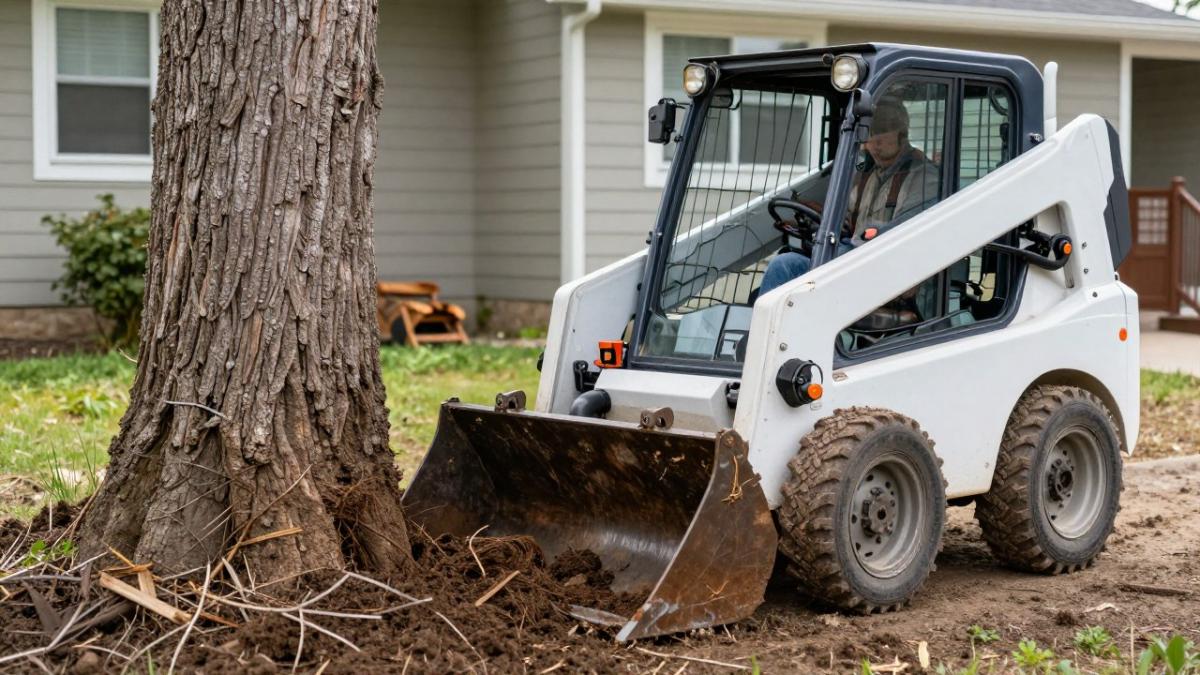
Start by digging a trench around the stump, about 12 to 18 inches out from the trunk. Work from several sides rather than one deep hole to expose the main lateral roots that anchor the stump.
As you dig, cut or break exposed roots with the bucket edge or a dedicated root cutter. Clean cuts make the stump easier to lift; a few well-placed cuts often do more than brute force.
Operator Technique for Loosening and Lifting
Once roots are exposed and cut, position the bucket or grapple firmly around the stump's base.
Apply steady, gradual pressure and rock the stump gently back and forth to break remaining root bonds.
When the stump releases, lift it clear of the hole and move it to a debris area before setting it down.
The core work breaks down into a few stages, each with its own practical checkpoints.
| Step | What to do | Key detail |
|---|---|---|
| Dig trench | Dig around the stump, about 12 to 18 inches out from the trunk | Work from several sides, not one deep hole |
| Cut roots | Cut or break exposed roots with the bucket edge or root cutter | A few clean cuts often beat brute force |
| Position attachment | Set the bucket or grapple firmly around the stump's base | Do not hook only the top of the trunk |
| Lift gradually | Apply steady pressure and rock the stump back and forth | Sudden jerks can snap the stump or stress the machine |
| Move debris | Lift the stump clear of the hole and set it in a debris area | Keep the machine on firm, level ground when possible |
When to Rent a Stump Grinder or Skid Steer Instead
Full removal is not always the best choice. The right method depends on what you plan to do with the space, how close the stump sits to structures and utilities, and how much time and equipment you can commit. Compare options on those terms rather than sticker price alone.
Digging and Pulling With a Skid Steer
Best when you need a clean, open hole for planting, a patio, a driveway, or a building pad, and the stump is accessible enough to work around from several sides.
- Strengths: Removes the root ball, not just the visible stump; leaves usable soil; handles multiple stumps efficiently during land clearing.
- Limits: Needs working room, firm ground, and a machine sized to the root ball. Close to a foundation, fence, septic field, or buried line, digging out can be riskier than grinding.
- Planning factors: Account for machine and attachment rental, transport fees, fuel, operator time, and debris disposal. A stump that takes an afternoon to loosen can take another hour to backfill and compact.
Stump Grinding
Best when you only need the stump below grade, for mowing, landscaping, or appearance, and when the stump sits close to a foundation, fence, sidewalk, or buried line where excavation is too risky.
- Strengths: Leaves the surrounding grade and turf largely intact; works in tight access; no large hole to backfill.
- Limits: Leaves roots and a mix of chips and soil behind; the spot can settle as roots decay; you can't plant or build directly over the grindings without removing them.
- Planning factors: Grinder rental or a contractor's minimum charge, the grinding depth you specify (typically 6-12 inches below grade), chip cleanup and disposal, and the fact that cost scales with stump diameter and the number of stumps.
Hand Excavation
Best for very small stumps, tight spots a machine can't reach, or situations where you want minimal disturbance.
- Strengths: Low equipment cost; precise around plants, irrigation, and pavement.
- Limits: Slow and physically demanding; impractical for stumps much over a foot across or for deep taproots.
Hiring a Professional
Best when the stump is very large, the soil is difficult, access is tight, or you lack the experience to run the machine safely. A contractor brings the right machine, the right attachment, and the judgment to know when pulling is too risky.
- Planning factors: Ask whether the quote covers grinding or full removal, how deep they grind, whether debris is hauled away, and whether the hole is backfilled and compacted. Those inclusions drive the real difference between quotes.
A Simple Decision Path
- If the spot will be planted or built on, plan for full removal, skid steer or professional.
- If the stump is near a structure, utility, or pavement, lean toward grinding.
- If the stump is small and access is tight, hand excavation may be enough.
- If the stump is large, the soil is heavy clay, or the ground is wet, price a professional before you rent.
Renting a stump grinder typically costs less up front than a full skid steer rental, but grinding leaves wood chips and roots behind. Weigh that against your plans for the space. Pricing varies, so get current local quotes and confirm what each includes.
Booking Your Stump Removal With Busy Man Contracting
If the job feels bigger than your equipment or your time allows, Busy Man Contracting LLC provides Bobcat services for stump grinding and lot grading.
Pricing depends on stump size, access, soil conditions, and debris handling. Before you call, read our guide on stump grinding and removal options and review how stump grinding compares to full stump removal.
If you are still deciding whether to hire out the work, our checklist of questions to ask a land clearing contractor walks through what to look for. You can also review the full range of services we offer, including grading, trenching, and gravel driveway work.
Busy Man Contracting LLC can help you reclaim the space. Request a quote today.
Frequently Asked Questions
Can a skid steer pull out a tree stump?
Yes, a skid steer can pull out many tree stumps, especially small to medium ones with shallow or moderately spread roots. The usual approach is to dig around the stump to expose the root collar, cut or break the major roots, then use a stump bucket or grapple to rock the stump and lift it free. Large stumps with deep taproots may need several passes from different sides, and very large or deep-rooted stumps often still require a stump grinder for the remainder.
How big of a stump can a skid steer remove?
Capacity depends on the machine's lift capacity, hydraulic flow and the attachment used, along with stump diameter, species and soil. Smaller skid steers handle small stumps, while larger units with a heavy stump bucket can remove considerably bigger ones. Check the manufacturer's rated operating capacity for your machine and attachment before starting, and avoid pushing the machine past its limits, which can cause tipping or hydraulic damage.
Is it better to dig out a stump or grind it?
Digging out a stump with a skid steer removes the root ball and leaves a hole you can backfill and level, which suits projects where you plan to build or plant on the spot. Grinding leaves the roots in the ground and is often faster and less disruptive to the surrounding landscape. Choose digging when you need the root system gone, and grinding when the stump is in a lawn or area where minimal soil disturbance matters.
What are common mistakes when removing a tree stump?
Common mistakes include skipping the utility locate call, failing to expose enough root to cut through the main roots, pulling at an angle that tips the machine, and working on soft or wet ground without support. Operators also often try to lift before the stump is loosened, which strains the hydraulics. Plan to backfill the hole with compacted soil and level it afterward so the site is safe and usable.